Table of Contents
- Which Cumin Variety Gives the Best Yield?
- What Decides Yield in a Cumin Variety?
- Why Disease Tolerance Matters So Much in Cumin?
- Why Variety Choice Changes by Region?
- Two Cumin Varieties Worth Knowing: AVANI-111 and AVANI-121
- AVANI-111
- AVANI-121
- Other Cumin Varieties You Will Hear About
- How to Choose the Right Cumin Variety for Your Field
- Seed Quality Matters as Much as the Variety
- Field Practices That Protect Yield with Any Variety
- What Dealers and Bulk Buyers Should Ask a Cumin Seeds Supplier?
- Frequently Asked Questions
- Conclusion
Cumin is a delicate crop. It likes cool, dry weather, it does not enjoy wet feet, and a few bad weeks of cloud and humidity can undo months of work. That is why the variety you choose often matters more than any other decision you make before sowing.
If you are a farmer, a dealer or a buyer working with a trusted cumin seeds supplier, this guide will help you understand what really makes a cumin variety high yielding. We cover the traits to compare, the varieties worth knowing, and the quality checks to make before you place an order.
Which Cumin Variety Gives the Best Yield?
There is no single best variety for every field. The best choice is the one that tolerates wilt and blight, fits your sowing window, produces plenty of umbels, and suits your region. For most growers in Gujarat, Rajasthan, Haryana and Madhya Pradesh, disease tolerance and a good number of umbels are the two traits to look at first.
What Decides Yield in a Cumin Variety?
When you read a variety description, these are the points that actually affect your harvest:
- Disease tolerance: Wilt and blight are the two biggest threats to cumin. A tolerant variety lowers your risk.
- Umbels and umbellets per plant: Cumin seed forms in these small flower clusters. More of them means more seed-bearing heads.
- Crop duration: A variety must finish well inside the cool rabi season, before the weather turns hot.
- Plant habit and height: Branching and plant structure affect how many clusters a plant can carry.
- Aroma and oil content: These decide the price you get in the market, especially from spice buyers.
- Seed quality: Even the best variety underperforms if the seed is mixed or weak.
Why Disease Tolerance Matters So Much in Cumin?
Wilt and blight are the two problems cumin growers fear most, and they behave differently.
- Wilt is caused by a soil-borne fungus. Plants droop, tips and leaves yellow, and young plants can die. The fungus stays in the soil, so a field that had wilt once is at risk again.
- Blight spreads through leaves and flower stalks, mostly in cloudy, humid weather. Brown spots appear and the crop can weaken quickly if the weather stays damp.
Once these diseases show up, sprays only reduce the damage. They do not bring back lost plants. A tolerant variety gives you protection from the start, which is why it is the first trait we suggest you compare.
Why Variety Choice Changes by Region?
Most of India's cumin comes from Gujarat and Rajasthan, with smaller areas in Haryana and Madhya Pradesh. Sowing usually happens from late October to November, and many growers aim for around mid-November. Late sowing tends to lower yield and can also bring more aphid trouble.
Soil and weather change from place to place, so a variety that does well in one district may do average in another. Always check what is recommended for your area before you buy in bulk.
Two Cumin Varieties Worth Knowing: AVANI-111 and AVANI-121
Our research team has developed two cumin varieties for Indian growers. Here is what each one offers.
AVANI-111
AVANI-111 matures in 85 to 95 days, which makes it the shorter-duration option. It has a semi-spreading habit, grows 35 to 45 cm tall and carries more clusters per plant. It is tolerant to blight and wilt.
AVANI-121
AVANI-121 matures in 105 to 115 days. It is also semi-spreading, with a height of 30 to 40 cm. It has a high number of umbels and umbellets, and it is bred for higher yield, high aroma and good oil content. It is resistant to blight and tolerant to wilt.
| Feature | AVANI-111 | AVANI-121 |
|---|---|---|
| Maturity | 85 to 95 days | 105 to 115 days |
| Plant habit | Semi-spreading | Semi-spreading |
| Plant height | 35 to 45 cm | 30 to 40 cm |
| Yield trait | More clusters per plant | High number of umbels and umbellets |
| Aroma and oil | Standard | High aroma and oil content |
| Disease response | Tolerant to blight and wilt | Resistant to blight, tolerant to wilt |
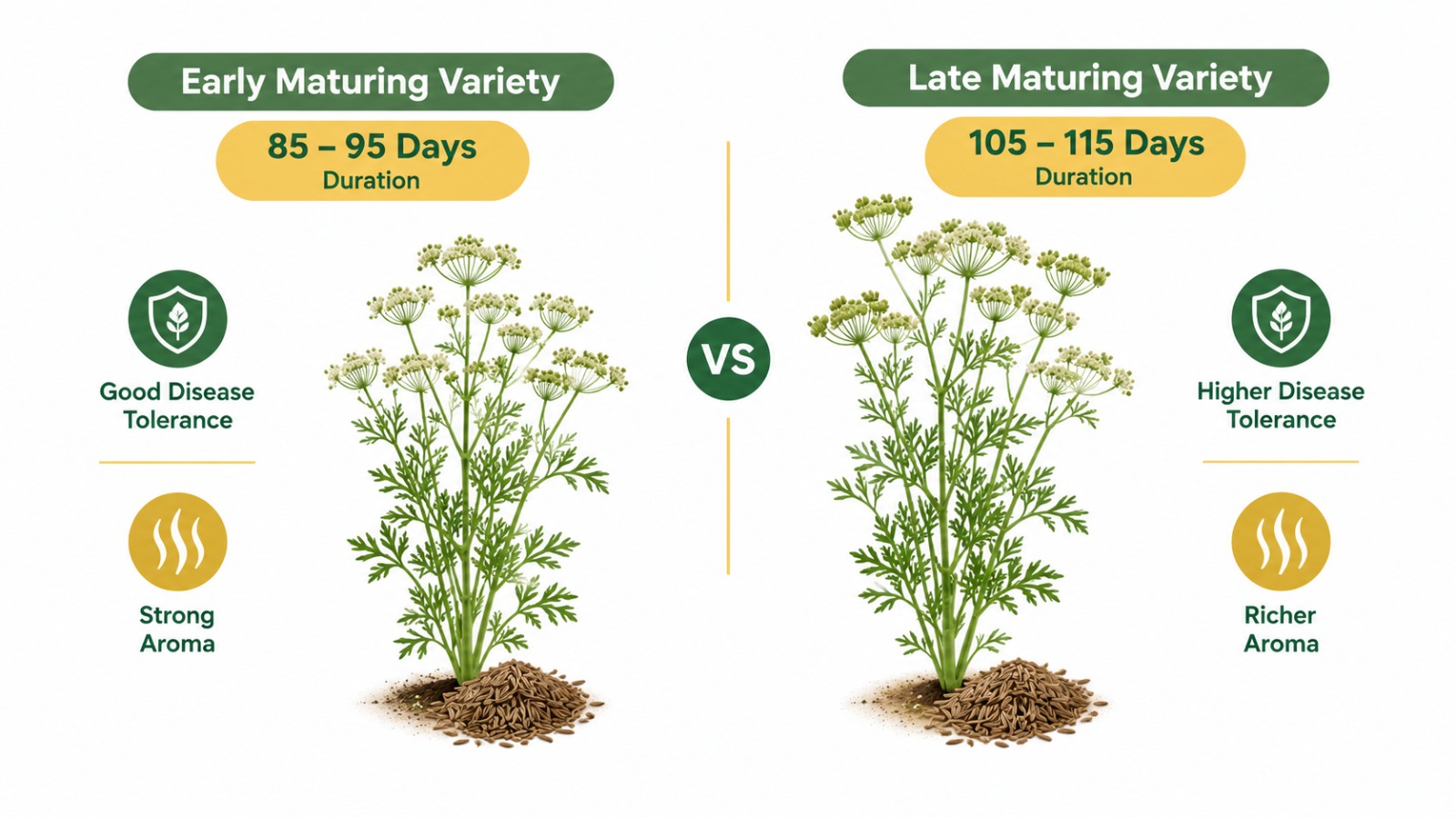
Both varieties suit growers in Gujarat, Haryana, Rajasthan and Madhya Pradesh. You can see the full details on our cumin seeds page.
Other Cumin Varieties You Will Hear About
Farmers also talk about public varieties released by agricultural universities. Three names come up often:
- GC-4: Widely grown in Gujarat and known for good yield and wilt resistance
- RZ-209: Recommended for Rajasthan and known for wilt tolerance
- RZ-223: Known for wider adaptability, wilt tolerance and good oil content
Traits and recommendations can differ by source and region, so confirm the latest advice with your state agricultural university or local KVK.
How to Choose the Right Cumin Variety for Your Field
Start with your biggest problem, then match the trait to it.
| If your priority is... | Look for | Why it matters |
|---|---|---|
| Fewer disease losses | Blight and wilt tolerance | These are the main causes of cumin crop loss |
| Higher yield per acre | Many umbels and umbellets, good branching | More seed-bearing clusters per plant |
| Better market price | High aroma, oil content and clean seed | Spice buyers pay more for quality |
| A tighter sowing window | A shorter crop duration | Helps the crop finish before warm weather |
| Regional fit | A variety recommended for your state | Better adaptation to soil and climate |
Seed Quality Matters as Much as the Variety
Many yield problems start with the seed, not the field. Mixed varieties, low germination and untreated seed can all hurt your stand. Before you pay, check the bag carefully:
| What to check | What to look for |
|---|---|
| Variety name | Clearly printed and matching what you ordered |
| Lot number | Present on both the tag and the bag |
| Purity and germination | Stated on the tag, with a valid test date |
| Seed treatment | Chemical names listed, if treated |
| Packing | Sealed, undamaged bag with a proper bill |
Our guide on the fight against fake seeds in India explains the warning signs in more detail.
Field Practices That Protect Yield with Any Variety
A good variety still needs good care. These habits make the biggest difference:
- Sow on time. Late sowing lowers yield and invites more pests.
- Choose well-drained, light soil and avoid waterlogged fields.
- Avoid fields where wilt was a problem in recent years.
- Use line sowing, so air moves freely between plants.
- Keep irrigation light and avoid overwatering, especially near flowering.
- Check the crop often in cloudy, humid weather, when blight and aphids spread fastest.
What Dealers and Bulk Buyers Should Ask a Cumin Seeds Supplier?
If you buy for a dealership, an FPO or a large group of farmers, the questions change a little. Before you place an order, ask your cumin seeds supplier:
- Which varieties are available, and what are their documented traits?
- Can you share test details for the lot you will receive?
- What are the packing sizes, and how early can you dispatch before sowing?
- How much stock can you commit for the full season?
- What support will your farmers get if a problem comes up?
If you are buying for overseas markets, you can also look at our exports page.
Frequently Asked Questions
Which cumin variety gives the highest yield in India?
It depends on your region, sowing date and disease pressure. Look for a variety with disease tolerance, many umbels and a duration that suits your area, and confirm it with your local agriculture office.
How many days does cumin take to mature?
Cumin usually matures in about 85 to 120 days, depending on the variety. For example, AVANI-111 takes 85 to 95 days and AVANI-121 takes 105 to 115 days.
Which cumin varieties are tolerant to wilt?
Several are. AVANI-111 and AVANI-121 are tolerant to wilt, and public varieties such as GC-4, RZ-209 and RZ-223 are also known for wilt tolerance or resistance.
When should cumin be sown in India?
Cumin is a rabi crop, sown from late October to November. Many growers in Gujarat and Rajasthan aim for around mid-November. Check your local advice for the best date.
How do I know if cumin seed is genuine?
Buy sealed, tagged bags with a lot number, variety name, test date and a proper bill. Avoid loose or unlabelled seed.
Conclusion
The best cumin variety is the one that matches your region, your sowing date and the problems your field usually faces. Compare disease tolerance, umbel count, crop duration and aroma before you decide, and always check the seed tag before you pay.
At Avani Seeds, we develop and supply cumin varieties like AVANI-111 and AVANI-121 with these needs in mind, and our team is happy to guide you on what suits your area. You can also explore our wider spices seeds range or read about our research work.
Planning your next cumin season or looking for a dependable cumin seeds supplier? Contact our team and we will help you choose the right variety.